
"How much does a septic system cost?" is the first question nearly every Southern Maine homeowner asks when a system starts failing — and the honest answer is that it depends on your soil, your lot, and what the design calls for. This guide walks through the real cost drivers so you can budget with realistic numbers instead of guesses.
Typical Cost Ranges for a New Septic System
Nationally, a conventional septic system installation generally runs in the range of $10,000 to $25,000, and full replacements on difficult sites can go higher. In Maine, several local factors push costs within — and sometimes beyond — that range:
- Soil conditions. Maine's glacial till, ledge, and high water tables often rule out the simplest (and cheapest) system designs. A site evaluation determines what the soil can actually absorb.
- System type. A conventional gravity system with a concrete tank and stone-and-pipe drain field costs far less than an engineered or chambered system required on poor soils or small lots.
- Lot access. Tight lots, mature trees, and long distances between the house and the field add excavation time and material handling.
- Permitting and design. Every new or replacement system in Maine requires a subsurface wastewater disposal application (HHE-200) prepared by a licensed site evaluator, plus local plumbing permits.
What a Full Septic System Replacement Includes
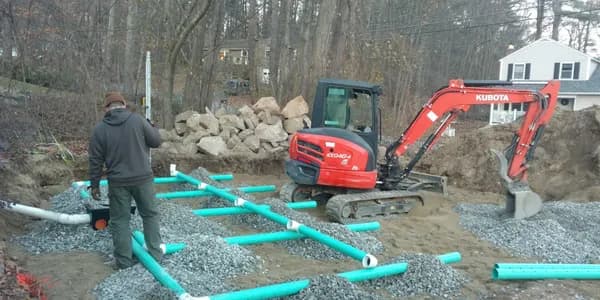
A septic system replacement is more than swapping a tank. A complete project typically covers the site evaluation and design, permitting, excavation and removal of the old components, the new tank, the distribution box, the new leach field, final grading, and inspection. Getting a single itemized estimate that covers all of these prevents surprise add-ons midway through the job.
When You Don't Need a Full Replacement
Not every failing system needs to be rebuilt from scratch — and a trustworthy contractor will tell you so. Common lower-cost fixes include:
- Distribution box replacement — a cracked or settled D-box causes uneven drainage that mimics total field failure, but replacing it costs a small fraction of a new system.
- Sewage pump replacement — pumps last 7–10 years; a dead pump can look like a failed system overnight.
- Sewer jetting — root intrusion or grease blockages in the line between the house and tank are cleared with high-pressure jetting, not excavation.
- Partial drain field repair — sometimes only a section of the field has failed and can be repaired or rested.
This is why a proper diagnosis matters: the cheapest replacement is the one you don't need.
How Maine Permitting Affects Cost and Timeline
Maine's Subsurface Wastewater Disposal Rules require a licensed site evaluator to test the soil and design the system before any digging starts. Design and permitting typically add both cost and a few weeks of lead time — which is another reason not to wait until sewage is backing up to address a system that's showing early warning signs. A contractor who handles the permitting for you, and coordinates directly with the site evaluator and your town's code enforcement office, removes most of the friction from the process.
Getting an Accurate Number for Your Property
Online cost ranges are a starting point, not a quote. The only way to get a real number is an on-site evaluation of your tank, field, soil, and lot. Septic Advisor provides free, written estimates for septic system installation and replacement across Portland, Gorham, Windham, Scarborough, and all of Southern Maine — with the design, permitting, excavation, and inspection handled by one team.
Call (207) 747-1472 or use the contact page to schedule a free estimate.
Related Topics: